
Technical vs Fundamental Analysis: The Battle for Market Truth
Ever find yourself staring at charts like you are deciphering an alien language, or reading economic news like it is bedtime fiction? You are not alone. In this guide, we break down the eternal struggle between the two most powerful ideologies in trading.
Report Briefing:
We break down the battle—think Batman vs. Superman, but with candlesticks and GDP reports. Discover how both methods work, why the industry wants you picking sides, and how using both might just turn you into a market wizard.
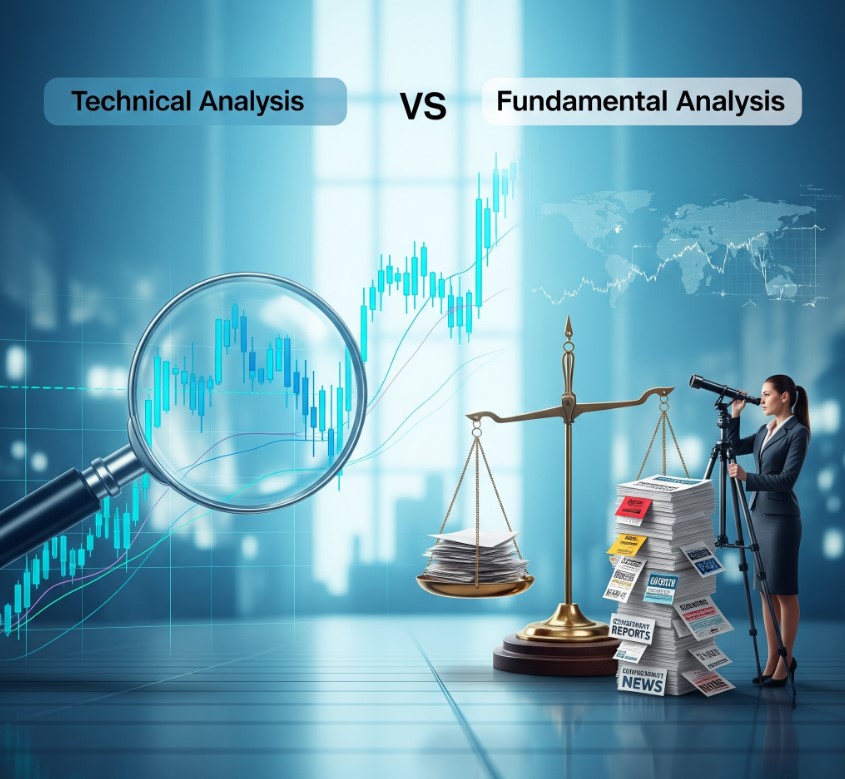
The Dual-Axis Protocol
Value Meets Price Action
The Industry Manipulation
Brokers want you to pick a “side” so you remain half-blind. A purely technical trader is just a liquidity provider for news-driven spikes. A purely fundamental trader is just a victim of B-Book liquidity hunts. To survive, you must use Fundamentals for Bias and Technicals for Execution.
1. Fundamental Analysis: The “Why” Behind the Move
Fundamental analysis is the forensic investigation into the economic soul of an asset. While retail traders are busy chasing flickering lines on a screen, institutional players are looking at the Macro Engine. This is the study of why a market should move, based on the cold, hard reality of interest rates, inflation, and geopolitical stability.
In the Forex world, this means deciphering Central Bank Policy. If the Federal Reserve adopts a “Hawkish” tone- signaling interest rate hikes to combat inflation- the USD becomes a magnet for global capital. If you don’t understand the Carry Trade or CPI prints, you are essentially gambling against the house with a blindfold on.
The “Dark Side” of fundamentals is that the news is often a lagging indicator for the retail crowd. By the time you read the headline on a major news site, the big banks have already positioned themselves. Professional fundamental analysis isn’t about reacting to the news; it’s about Anticipating the Sentiment before the data is even released.
Fundamentalists ask the hard questions: “Does the current employment data support a rate hike, or is the market overextended on pure hope?” Understanding this protects you from entering manipulated price spikes that occur during high-impact news events like the NFP.

Institutional Data Stream • Non-Lagging Intelligence
Technical Analysis: Decoding the Digital Crime Scene
Technical analysis is the art and science of reading price charts to anticipate where the next mass movement of capital will occur. It operates on a single, powerful premise: “The price discounts everything.” This means that every geopolitical crisis, interest rate hike, and corporate scandal is already reflected in the flickering candles on your screen. You aren’t just looking at lines; you are looking at the collective psychological footprints of millions of traders, ranging from retail gamblers to institutional algorithms.
While fundamental analysis tells you why a market should move, technical analysis is the forensic tool that tells you when it is actually happening. It treats the historical price action as a digital crime scene where history tends to repeat itself because human emotions- specifically fear and greed- remain constant regardless of the decade or the asset class.
The Structural Mechanics
This involves the study of candlestick geometry, support and resistance zones, and market structure. By identifying where the big banks have placed large orders (Order Blocks) and where retail traders are likely to be stopped out, you can map the path of least resistance. This is the “When” of the trading equation, allowing for sniper-like entries into established trends.
The Indicator Paradox
Tools like the RSI, MACD, and Bollinger Bands are mathematical derivatives of price. They don’t predict the future; they summarize the past. Professional technicians use them as secondary filters to spot “divergence” or exhaustion points. They are the health monitors of a trend, telling you if the current move is backed by real momentum or if it is running on fumes.
The Dark Side of the Chart
Here is the truth the industry won’t tell you: Most retail technical analysis “patterns” are taught specifically so you can become liquidity for the big players. Brokers love to promote “complex” technical strategies because they lead to over-analysis and high-frequency trading. Every time you click that mouse based on a lagging indicator, the broker collects their spread.
To win, you must stop using technicals as a crystal ball and start using them as a Liquidity Map. You need to know where the retail crowd is hiding their stops so you can enter when they get flushed out. This is the difference between being a victim of the market and being a forensic operator who understands the A-Book vs B-Book reality.
Forensic Charting • Price Action Truth
The Side-By-Side Audit
| Feature | Fundamental Analysis | Technical Analysis |
|---|---|---|
| Primary Objective | Determine Intrinsic Value | Predict Price Direction |
| Time Horizon | Long-Term (Months/Years) | Short-Term (Minutes/Weeks) |
| Core Data | Economic Reports, News, Interest Rates | Price History, Volume, Patterns |
| Main Question | “Why is the market moving?” | “What is the price doing now?” |
| Common Pitfall | Analysis Paralysis / News Lag | Analysis Subjectivity / False Signals |
Strategy: How to Combine Them Like a Professional Operator
The most profitable traders- those who treat the markets as a forensic business rather than a high-stakes hobby- never pick a side in the technical vs. fundamental war. They understand that the market is a multi-dimensional beast. They use Fundamentals to identify the “Value Gap” and Technicals to map the “Execution.”
This is the “Top-Down” protocol used by institutional desks. While retail traders are busy arguing on Twitter about whether a trendline is “broken,” the professionals are looking at how interest rate differentials create the gravitational pull that moves price toward those lines in the first place. By merging both, you stop being the liquidity and start following the smart money flow.
The 4-Step Forensic Execution
- Establish the Macro Bias: Your day begins with the economic calendar, not the chart. You are looking for divergence. Is the Federal Reserve hawkish while the ECB is dovish? That interest rate spread creates a fundamental “wind” at your back. If the macro bias is bullish, you delete the “Sell” button from your mind. You only hunt for entries that align with the global money flow.
- Filter for Technical Confluence: Now you open the charts. You aren’t looking for random patterns; you are looking for Institutional Footprints. Identify major weekly and daily supply/demand zones that align with your macro bias. When a fundamental trend hits a technical support level, you have a high-probability “Confluence Zone.” This is where the house edge shifts in your favor.
- The Forensic Timing: Move to the lower timeframes (1H or 15M) to refine your entry. Look for signs of retail exhaustion- like RSI divergence or a failed breakout. You want to enter where the “weak hands” are getting stopped out. By using technicals for the sniper shot, you can keep your stop losses tight and your Risk-to-Reward ratios high.
- The News Reality Filter: Never let a technical pattern blind you to an upcoming “Black Swan.” If the NFP (Non-Farm Payroll) or a Central Bank press conference is scheduled, you flatten your position or move to break-even. In the battle between a 10-year trendline and a surprise interest rate hike, the fundamental news will win every single time.
To truly master this dual-threat approach, you must move beyond basic charting and embrace structural risk management. Without a forensic plan, you are just a gambler with a fancy vocabulary. If you are ready to stop being the house’s favorite customer, you need to dive into our advanced risk protocols to ensure your account survives the inevitable fundamental spikes that wipe out the retail herd.
“In trading, it’s not about being right- it’s about being disciplined enough to stay solvent.”
Every profitable trader knows that emotions can ruin even the most perfect technical or fundamental setup. You can have the most advanced RSI settings, a custom-built AI algorithm, and macro reports so detailed they’d make a Central Bank governor sweat, but if you have the emotional stability of a toddler on a sugar high during volatility, the market will find you. And it will eat you.
The “House” doesn’t win because they have better math; they win because they have better ice in their veins. While you are busy “revenge trading” at 3 AM because a candlestick didn’t respect your feelings, the institutional algorithms are simply executing a protocol. They don’t get angry when they lose, and they don’t buy a Lambo in their head when they win.
Real talk: Discipline is the boring part that actually makes the money. It is the ability to walk away when there is no setup and the courage to take a loss without doubling down like a degenerate at a blackjack table.
Discipline, patience, and sticking to your protocol is what separates the 5% of professional operators from the 95% of accidental donors who provide the exit liquidity for the banks. Technicals and fundamentals are just maps. Without discipline, you are just a guy with a map and no fuel, standing in the middle of a desert wondering why you aren’t at the oasis yet.
Unfold The Truth. Stay Solvent.
Master the Markets: The Forensic Library
The financial industry thrives on your ignorance. Most brokers want you to treat the markets like a casino because the “house” always wins against the uninformed. We are here to change that. Below is our curated list of forensic trading guides designed to help you unfold the truth about market mechanics, institutional traps, and the psychological warfare of price action.
Our mission is simple: To unfold the truth about the dark side of Forex and CFD trading. Whether you are navigating the complexities of Fundamental Analysis or the high-frequency world of Technical Patterns, your only real edge is knowledge. Don’t be another statistic in a broker’s B-book. Educate, Execute, and Evolve.
TRADEUNFOLD.COM
 TradeUnfold