
The Execution Engine: Why Your Choice of Order is the Broker’s Biggest Weapon
In the retail trading complex, order types are marketed as “convenience tools.” In technical reality, they are the binary instructions that dictate who profits from your trade. If you do not understand the mechanics of execution, you aren’t trading- you are just providing liquidity for the house.
Report Briefing:
We are unfolding the structural truth behind market, limit, and stop orders. From the dark side of slippage to the algorithmic traps set by B-Book servers, this is the forensic guide to taking control of your entry and protecting your capital.

The Order Toolbox: Engineering Your Edge
Most beginners treat their trading platform like a video game console. They hit a button and expect the market to obey. However, the plumbing of the financial world is far more calculated. Every instruction you send carries a priority level and a hidden cost that brokers rarely mention in their “educational” PDFs.
To survive the forex broker conflict of interest, you must view order types as defensive gear. A market order is a blunt instrument that sacrifices price for speed. A limit order is a sniper rifle that demands precision. Using the wrong one during high volatility does not just cause a bad fill. It creates a systematic leak in your equity that can wipe out months of gains.

1. Market Orders: The Price of Impatience
What It Actually Is
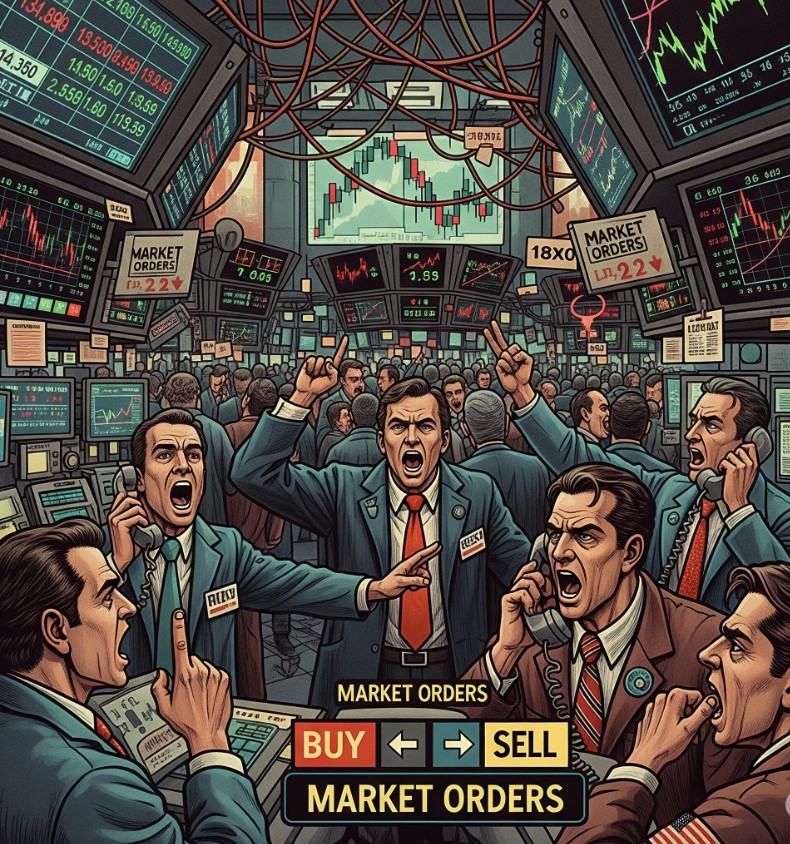
Think of a Market Order as walking into a store and saying “I don’t care what the price tag says, I want this item right now.” You are prioritizing speed over cost. You are telling the broker to fill your order immediately at whatever price is currently available. While this ensures you get into the trade quickly, it leaves you completely wide open to whatever price the broker decides to give you.
Forensic Example: The Instant Loss
Imagine you are watching NVDA at $120.50. You click “Buy Market” because you are afraid of missing the move.
- The Price You Saw: $120.50
- The Spread: The broker has a 5-cent spread, so the “Ask” is actually $120.55.
- The Slippage: In the millisecond you clicked, a high-frequency algorithm bought the liquidity. You get filled at $120.60.
- The Reality: You are already down 10 cents per share before the chart even moves.
The Danger of “Slippage”
Slippage happens when the price you see on your screen is not the price you get in your account. If the market is moving fast, the price can jump in the milliseconds it takes for your click to reach the broker’s server. Because a market order has no price limit, the broker can fill you pips or cents away from your target. You have zero protection against this.
- Speed: Instant (You get filled now).
- Control: None (You are at the mercy of the market).
- Best for: Emergency exits when the trade has gone horribly wrong.
- Worst for: Precise entries where every pip counts toward your profit.
Forensic Truth:
Brokers love market orders because they are “liquidity takers.” You are helping the broker clear their books while they pocket the widest possible spread. Never be the liquidity that the house feeds on.
2. Limit Orders: The Sniper Protocol
If a market order is a desperate plea for a fill, a Limit Order is a professional demand. You are telling the broker that you will only enter the market if they can meet your exact price or better. You are no longer asking for permission to trade. You are setting the rules of the engagement.
Buying with Precision (Entry)
When you use a Buy Limit, you place your order below the current market price. You are waiting for the market to come to you. This ensures that you never “chase” a green candle. If the market gaps down or spikes, your limit order acts as a shield.
Entry Example: Tesla is trading at $252.00. You believe it is overpriced but want to own it at $250.00. You set a Buy Limit at $250.00. This is the absolute maximum you are willing to pay. If the stock never drops to $250.00, you don’t buy. If it drops to $249.50, the broker fills you at $250.00 or better. You have controlled your cost to the penny.
Selling with Logic (The Take Profit)
A Take Profit is technically just a Sell Limit order placed above your entry. It is the most vital part of your stock or CFD strategy.
Take Profit Example: You bought Apple at $190.00. You want to exit once you make a $10 profit. You set a Sell Limit (Take Profit) at $200.00. The moment the price hits $200.00, the broker sells your position. You don’t have to watch the screen, and you don’t have to worry about the broker “slipping” your exit price. Your profit is locked in exactly where you planned.
By utilizing limit orders for both your entry and your exit, you create a “mathematical cage” around your trade. You remove the emotional urge to click buttons and you force the broker to provide the liquidity at your price.
The Professional Mandate:
Limit orders allow you to be a “liquidity provider.” In the real world of institutional finance, being a provider means you get better fills and lower costs. Chasing the market with market orders is a retail habit that the 1% exploits daily.
3. Stop Orders: The Entry vs. The Exit
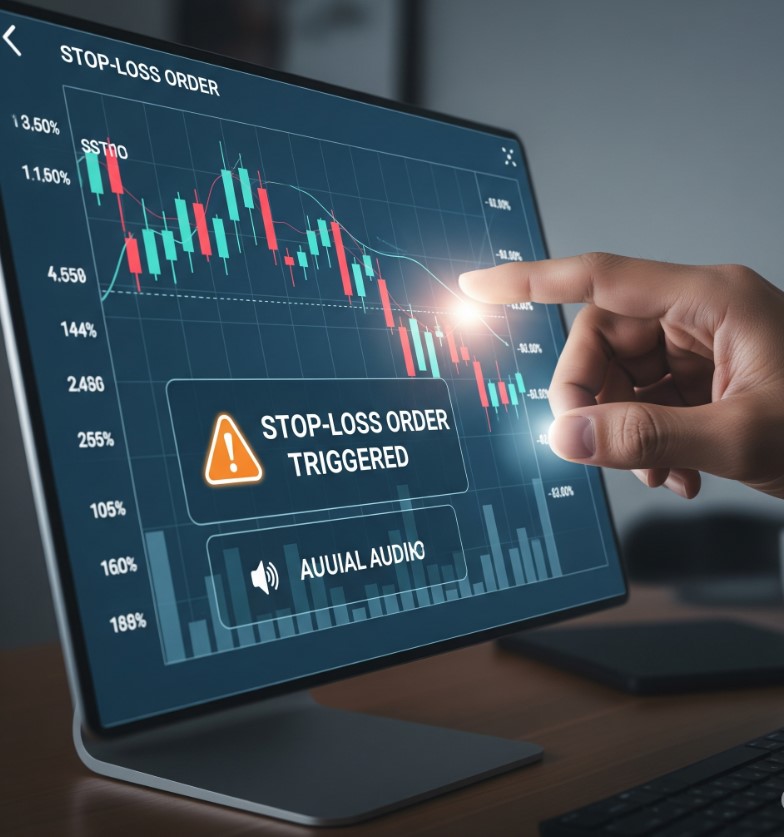
Stop orders are your emergency parachute. They are designed to activate only when the price hits a specific trigger point. Unlike a limit order, which sits and waits for a specific price to be given to you, a stop order waits for a price to be hit and then immediately converts into a market order. This makes it a double edged sword that can either save your account or lead you straight into a liquidity trap.
The Stop Entry: Catching the Momentum
Buy Stop: Place this above the current market price to catch momentum or enter a new position as a breakout occurs. You are telling the broker that if the price rises to this point, you want to buy immediately.
Entry Example: Bitcoin is trading at $64,000. You believe that if it hits $65,000, it will rocket to $70,000. You place a Buy Stop at $65,000. The second it hits that price, you are filled at the next available market price.
The Stop Loss: Your Survival Exit
Sell Stop: If the price falls to this point, you sell to cut losses or protect your capital. It is your primary tool for risk management.
Exit Example: You bought Gold at $2,050. You place a Sell Stop at $2,030. If Gold crashes and touches that price, your order wakes up and sells your position. This prevents a small loss from turning into a total account liquidation.
Great for those “set it and forget it” moments unless the market plays tricks on you. Always remember that once triggered, these become market orders, and your execution price may differ in volatile markets due to slippage.
Technical Audit:
- → Execution: Converts to a market order upon trigger.
- → Use Case: Emergency exits or momentum entries.
- → Warning: No price protection once the tripwire is hit.
Precision requires understanding that a stop is a command to act, not a guarantee of price.
4. Advanced Armor: Stop-Limit & Trailing Logic
Standard stop losses have a major flaw. They turn into market orders when triggered. This means in a fast moving crash, your broker can fill you at a price far worse than you intended. A Stop-Limit Order fixes this by adding a secondary safety layer. It uses a “Stop” price to trigger the order and a “Limit” price to set the boundary. If the market gaps past your limit, the order will not execute. You are choosing to keep your asset rather than accepting a toxic price.
Example: The Stop-Limit Shield
Imagine you own a stock at $100. You set a Stop Price at $95 and a Limit Price at $94. If the price hits $95, your order becomes active. However, if the market suddenly gaps down to $90 during a news event, your order will not fill. You have effectively told the broker that you would rather hold the stock than sell it for anything less than $94. This prevents the “flash crash” liquidation that many retail traders suffer from.
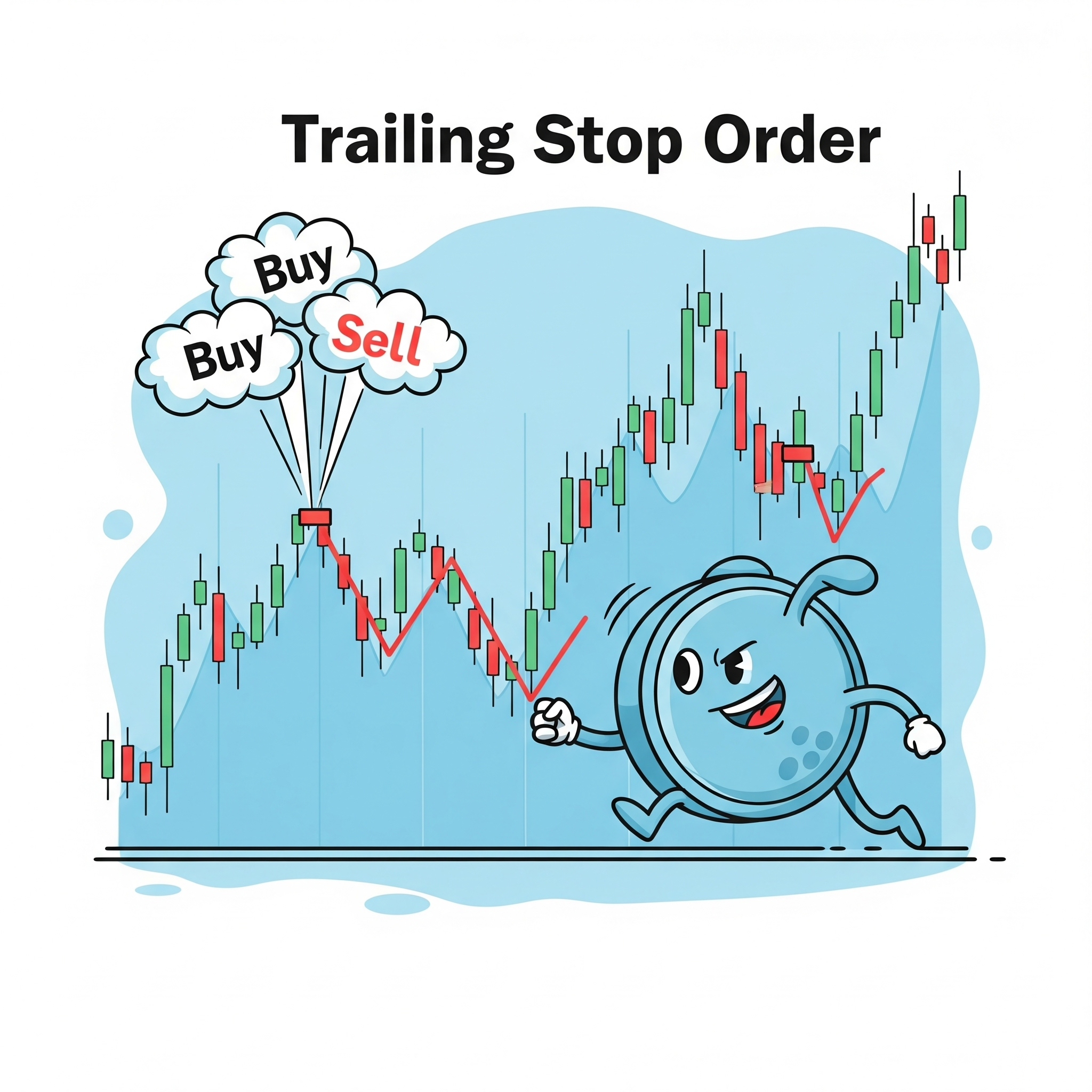
The Trailing Stop is your offensive defense. Instead of a fixed price, it stays a set distance behind the current market price as long as the market is moving in your favor. It automates the process of “locking in” profit without cutting your winners too short.
Example: The Trailing Profit Shadow
You enter a trade at $1.1000 and set a 50-pip trailing stop. As the price climbs to $1.1100, your stop automatically moves up to $1.1050. If the price continues to $1.1200, your stop follows to $1.1150. If the market suddenly reverses and drops to $1.1150, you are taken out of the trade with a 150-pip profit already secured. Your profit grows as the trend grows, but your risk is capped.
5. Bracket Orders: The OCO Protocol
A Bracket Order is the ultimate survival system for the modern trader. It is a sophisticated multi-leg instruction that wraps your entry in two protective layers: a Take Profit and a Stop Loss. These orders are connected by OCO logic, which stands for One Cancels the Other. This means the moment one of your targets is hit, the other is instantly deleted by the server.
Why the House Hates Brackets
Brokers and market makers thrive on your emotional instability. They want you to panic and move your stop loss further away when a trade goes south. They want you to get greedy and “cancel” your take profit right before the market reverses. A Bracket Order removes the human element entirely.
Once the trade is live, the instruction sits on the server. There is no middle ground for the broker to exploit your hesitation. You have committed to a mathematical outcome before the adrenaline of the move clouds your judgment.
The OCO Example: Full Automation
Imagine you are trading Gold at $2,000. You set a Bracket Order with a Buy Limit at $1,990. Attached to this are two “legs”: a Take Profit at $2,020 and a Stop Loss at $1,980.
- Scenario A: Price hits $2,020. You bank $30 profit. The server automatically kills the $1,980 stop loss so you aren’t left with a “ghost” order.
- Scenario B: Price drops to $1,980. You exit with a $10 loss. The server automatically kills the $2,020 take profit. Your risk is closed.
By utilizing brackets, you are applying institutional execution logic to your personal account. You are no longer “playing the market” but managing a probability machine.
The Survival Flow
- 01. Entry: Price-Specific Limit
- 02. Target: Fixed Reward Exit
- 03. Safety: Hard Stop Protocol
- RESULT: PURE MATH
The broker cannot trade against your emotions if your emotions are removed from the server.
Neuromarketing: The Psychological Trap of Speed
There is a reason why brokers put big, bright “One Click” buttons right in the middle of your screen. It is a psychological tactic designed to bypass the logical, calculating part of your brain. By making trading feel as easy as liking a photo on social media, they encourage you to act on impulse rather than on a plan.
The Science of the Click
When you trade with a single click, you are almost always using a market order. This behavior is high frequency and low thought. For the broker, this is perfect. Each impulsive click generates spread revenue and often pushes you into a high leverage trap where your margin is at risk before you even realize what happened.
Real professionalism is intentionally slow. It requires the patience to set a limit order and the discipline to walk away while the market decides whether to meet your price. To truly understand why your brain craves the speed of market orders, you should study our trading psychology guide and learn how to identify common trading biases that lead to liquidation.
Professional traders do not play the market. They execute a strategy. If your process does not involve calculating risk to reward ratios and using automated brackets, you are not trading. You are participating in a game where the house has rigged the buttons to ensure you lose in the long run. If you want to dive deeper into the mindset of the 1%, check out our list of the best psychology finance books.
The Professional Difference
- ✕ One Click Trading: Emotional, fast, expensive, and reactive execution.
- ✔ Limit & Bracket Orders: Logical, slow, cost effective, and proactive strategy.
Stop acting like a customer and start acting like a technician. Your broker is counting on your lack of discipline.
Stock Execution: TIF (Time In Force) Protocols
In the world of real equities, an order isn’t just about price- it’s about time. Unlike the “instant” world of Forex, stock exchanges operate on specific duration protocols. If you don’t understand these, your orders will “vanish” at the market close, or worse, fill during a low-liquidity after-hours session.
GTC: Good ‘Til Canceled
A GTC order stays live until it is filled or you manually kill it. Most brokers set a 60-90 day limit. Professionals use these for long-term accumulation zones, but the risk is high: a GTC order left forgotten can fill months later during a flash crash, catching you completely off guard.
Understanding these nuances is the bridge between gambling and CFD vs Stock Investing. One is a bet on price; the other is a strategic ownership of an asset.

The “Immediate” Orders
FOK (Fill or Kill): The entire order must be filled immediately at your price, or the whole thing is canceled. No partial fills. No games.
IOC (Immediate or Cancel): Any portion of the order that can be filled at your price is taken; the rest is discarded.
EXT: The Dangers of Stock Market After-Hours
In the real stock market, trading does not stop when the closing bell rings. You can enable Extended Hours (EXT) execution to participate in pre-market (before 9:30 AM EST) and after-hours (after 4:00 PM EST) sessions. While this provides an opportunity to react to earnings reports or news, it is a high-risk environment where institutional algorithms hunt for retail mistakes.
The “Limit Only” Rule
Most reputable stock brokers prohibit market orders during extended hours. You are forced to use Limit Orders. This is because liquidity is paper-thin. Without the protection of a limit price, a single trade could cause a massive, artificial price spike that would liquidate your account instantly.
A major risk in the stock market is leaving an “empty” or “stale” limit order active. If you set a Buy Limit during the day and it does not fill, but you have checked the GTC + EXT (Good Til Canceled + Extended) box, that order stays live. You might wake up to find you bought a stock at 5:00 AM because of a random price wick, even if the price stabilized by the time the actual market opened.
Stock Session Protocols
- Pre-Market: Limit Orders Only. Very low volume.
- Standard Session: Full order suite available. High liquidity.
- After-Hours: Limit Orders Only. Extreme volatility.
- WARNING: Spreads can widen by 500% after the bell.
Always verify your “Time in Force” settings. If you do not intend to trade in the dark, ensure your orders are set to “Day” and do not include “EXT” sessions.
The PFOF Scandal: How Your Order Data is Sold
Choosing the right order type is only half the battle. The other half is understanding who sees that order before it reaches the market. If you are trading stocks on a “zero commission” app, you are likely part of the Payment for Order Flow (PFOF) machine. This means your broker does not send your order directly to the New York Stock Exchange. Instead, they sell the right to execute your order to massive market makers like Citadel or Virtu.
The Connection to Order Types
PFOF turns your Market Orders into pure gold for high frequency traders. Because a market order has no price protection, the firm buying your order data can fill you at the absolute edge of the spread and pocket the difference. Even your Limit Orders are at risk. These firms see your “hidden” price levels before they are filled, allowing them to adjust their own algorithms to trade right in front of you.
The Conflict of Interest
To be fair, PFOF is not always a disaster for the retail client. Occasionally, these market makers provide “price improvement,” filling your order at a slightly better price than what is available on the public exchange to keep the flow coming. However, you must stay aware of the other side of the trade.
The market maker is your counterparty. They only give you a better fill if it serves their larger statistical model. If they see a massive wave of sell orders coming, they might fill your buy order instantly just to get rid of their own inventory before the price collapses. You are getting a “good fill” into a falling knife.
To combat this, professional investors use Direct Market Access (DMA) brokers. By paying a small transparent commission, you ensure your limit orders bypass these middlemen and go straight to the exchange. This is a fundamental pillar of the CFD vs Stock Investing debate. In one, you are trading against a house that sees your cards; in the other, you are fighting for a fair fill on a public floor.
The Forensic Conclusion:
A “free” trade is a marketing illusion. Whether through wider spreads or selling your data, the cost is always there. Precision order types work best when they aren’t being filtered through a middleman with a conflicting interest.
The Execution Audit: Check Before You Click
A strategy is only as good as its execution. Before you commit capital to a live server, you must verify that your order instructions are designed to protect you rather than serve the broker. Use this forensic checklist to audit every trade you take.
- ✔ Ditch Market Orders: Are you entering with a Limit order to avoid the “Broker Tax”? Remember that market orders are high priority for the broker because they maximize the spread they collect from you.
- ✔ Audit the Stop: Is your Stop Loss a “Stop Market” trap or a “Stop Limit” shield? Using a limit boundary ensures you aren’t liquidated at a predatory price during a flash crash.
- ✔ The Bracket Rule: Have you automated your exit and profit target before the trade is live? If you aren’t using OCO (One Cancels the Other) logic, you are leaving your account open to human error and emotional manipulation.
- ✔ Session Protocol: If trading the Stock Market, have you checked your EXT (Extended Hours) settings? Ensure you aren’t leaving “stale” limit orders active during low liquidity sessions.
- ✔ Spread & Wick Audit: Did the broker widen the wicks to hunt your resting liquidity? Forensic analysis of your fills will reveal if your Forex broker is manipulating the feed.
- ✔ Slippage Records: Are you tracking the difference between your requested price and the final fill? Consistent slippage is a sign of PFOF or B-Book execution.
Advanced Intelligence Deep Dive
Mastering order types is a technical skill, but maintaining the discipline to use them is a psychological one. To build a complete professional foundation, we recommend exploring these essential resources:
 TradeUnfold